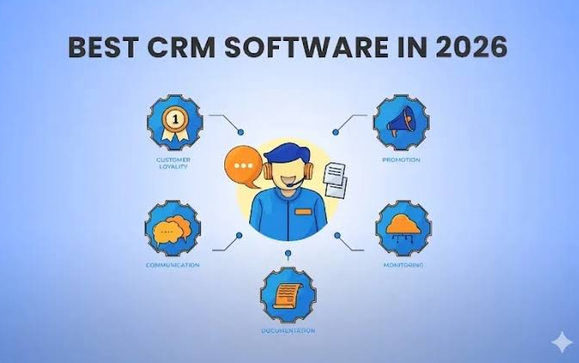
Customer Relationship Management (CRM) software has become one of the most valuable business tools for companies of all sizes. Whether you operate a small startup, an expanding eCommerce store, a service-based company, or a large enterprise, choosing the right CRM can significantly improve customer relationships, increase sales, automate workflows, and boost overall productivity.
In 2026, CRM software has evolved far beyond contact management. Modern CRM platforms now integrate artificial intelligence (AI), predictive analytics, workflow automation, omnichannel communication, customer support, marketing automation, and advanced reporting into one centralized system.
However, with hundreds of CRM solutions available in the market, selecting the right one can be overwhelming. Every software vendor claims to offer the best features, lowest pricing, and highest return on investment.
This comprehensive guide explains everything you need to know before choosing the best CRM software for your business in 2026.
What is CRM Software?
CRM (Customer Relationship Management) software is a digital platform designed to help businesses manage customer information, sales activities, communications, marketing campaigns, and customer service from one centralized location.
Instead of using spreadsheets, notebooks, and disconnected applications, businesses can organize all customer interactions within a single system.
A CRM typically stores:
- Customer profiles
- Contact information
- Purchase history
- Email conversations
- Phone calls
- Sales opportunities
- Meeting notes
- Customer support tickets
- Marketing campaign history
- Documents and contracts
The goal is simple:
Build stronger customer relationships while increasing efficiency and revenue.
Why CRM Software Matters More Than Ever in 2026
Today’s customers expect fast responses, personalized experiences, and seamless communication across multiple channels.
Without CRM software, businesses often struggle with:
- Lost leads
- Poor follow-ups
- Duplicate customer data
- Missed sales opportunities
- Inefficient teamwork
- Limited reporting
- Manual administrative work
Modern CRM platforms solve these challenges through automation and AI-powered insights.
Businesses using CRM effectively often experience:
- Higher customer retention
- Increased sales conversions
- Better employee productivity
- Improved customer satisfaction
- More accurate forecasting
- Stronger marketing performance
Step 1: Identify Your Business Goals
Before comparing CRM software, define what you actually need.
Ask yourself:
- Why are we buying CRM software?
- What problems are we trying to solve?
- Which departments will use it?
- What results do we expect?
Some common business goals include:
Increasing Sales
Sales-focused companies prioritize:
- Lead management
- Pipeline tracking
- Sales forecasting
- Deal management
- Activity reminders
Improving Customer Service
Support teams may require:
- Ticket management
- Live chat
- Knowledge base
- Case tracking
- Customer history
Marketing Automation
Marketing departments often look for:
- Email campaigns
- Customer segmentation
- Landing pages
- Lead scoring
- Campaign analytics
Business Automation
Many organizations simply want to automate repetitive tasks like:
- Follow-up emails
- Appointment scheduling
- Invoice reminders
- Workflow approvals
Step 2: Understand Your Business Size
Not every CRM fits every company.
Your business size should influence your decision.
Small Businesses
Look for:
- Affordable pricing
- Easy setup
- User-friendly interface
- Basic automation
- Email integration
Avoid overly complex enterprise platforms.
Medium Businesses
Growing companies benefit from:
- Advanced automation
- Sales forecasting
- Team collaboration
- Workflow customization
- Marketing tools
Large Enterprises
Enterprise organizations usually require:
- Multi-department support
- Advanced security
- AI capabilities
- API integrations
- Global scalability
- Role-based permissions
Step 3: Choose Cloud or On-Premise CRM
One of the biggest decisions is deployment.
Cloud CRM
Cloud CRM is hosted online.
Advantages include:
- Accessible anywhere
- Lower upfront costs
- Automatic updates
- Faster implementation
- Better scalability
Cloud CRM is the preferred option for most businesses in 2026.
On-Premise CRM
Installed on company servers.
Benefits include:
- Greater control
- Internal data hosting
- Custom infrastructure
However, it requires:
- IT staff
- Maintenance
- Security management
- Hardware investment
Step 4: List Essential CRM Features
Different businesses require different functionality.
Here are the most important CRM features to evaluate.
Contact Management
A CRM should organize:
- Customers
- Leads
- Vendors
- Partners
- Suppliers
Everything should be searchable and easily accessible.
Lead Management
The software should help:
- Capture leads
- Assign leads
- Track progress
- Score leads
- Convert prospects
Sales Pipeline
Visual pipelines make it easy to monitor deals from first contact to closing.
Look for:
- Drag-and-drop stages
- Custom pipelines
- Sales forecasting
- Win/loss tracking
Workflow Automation
Automation saves valuable time.
Examples include:
- Welcome emails
- Lead assignment
- Task reminders
- Invoice creation
- Meeting scheduling
Email Integration
CRM should integrate with:
- Gmail
- Outlook
- Microsoft 365
Benefits include:
- Email tracking
- Templates
- Scheduling
- Open notifications
Calendar Management
Integrated calendars improve scheduling.
Features include:
- Meetings
- Appointments
- Follow-ups
- Team availability
Mobile Access
Modern businesses operate everywhere.
Choose CRM software with:
- Android app
- iPhone app
- Tablet support
- Offline access
AI Features
Artificial Intelligence is becoming a standard CRM feature.
AI can help with:
- Predictive sales
- Customer recommendations
- Automated emails
- Meeting summaries
- Lead scoring
- Chatbots
Customer Support Tools
Good CRM systems often include:
- Help desk
- Ticket management
- Customer portal
- Live chat
- Chatbots
Reporting Dashboard
Data-driven decisions require strong analytics.
Look for:
- Sales reports
- Marketing reports
- Revenue forecasting
- Team performance
- Customer insights
Step 5: Consider Ease of Use
Complicated software often leads to poor adoption.
Ask yourself:
- Is the interface clean?
- Can employees learn it quickly?
- Is navigation intuitive?
- Are workflows simple?
A CRM should improve productivity—not create frustration.
Step 6: Evaluate Customization Options
Every business operates differently.
Choose CRM software that allows customization.
Examples include:
- Custom fields
- Custom dashboards
- Sales stages
- Reports
- Workflow automation
- User permissions
Flexible software grows with your business.
Step 7: Check Integration Capabilities
Your CRM should work with your existing tools.
Common integrations include:
Accounting
- QuickBooks
- Xero
Marketing
- Mailchimp
- ActiveCampaign
- Constant Contact
Communication
- Zoom
- Microsoft Teams
- Slack
eCommerce
- Shopify
- WooCommerce
- Magento
Payment Platforms
- Stripe
- PayPal
Project Management
- Trello
- Asana
- Monday.com
The fewer manual data transfers you perform, the more productive your business becomes.
Step 8: Understand Pricing Models
CRM pricing varies significantly.
Common pricing structures include:
Free Plans
Suitable for:
- Freelancers
- Startups
- Small businesses
Limitations often include:
- Fewer users
- Limited storage
- Basic automation
Monthly Subscription
Most cloud CRM providers charge per user each month.
Benefits:
- Flexible
- Easy upgrades
- Lower upfront investment
Annual Plans
Annual billing often includes discounts.
Ideal for businesses planning long-term use.
Enterprise Pricing
Large organizations typically receive:
- Custom pricing
- Dedicated support
- Personalized onboarding
- Advanced security
Step 9: Think About Scalability
Your CRM should support future growth.
Questions to ask:
Can it support:
- More employees?
- More customers?
- Additional departments?
- International operations?
- Multiple currencies?
- Multiple languages?
Replacing CRM software later can be expensive.
Choose a platform built for long-term expansion.
Step 10: Review Security Features
CRM systems store sensitive customer information.
Essential security features include:
- Two-factor authentication
- Data encryption
- Backup systems
- User permissions
- Audit logs
- Secure cloud hosting
Security should never be an afterthought.
Step 11: Compare Customer Support
Reliable customer support can save hours of downtime.
Evaluate:
- Live chat
- Email support
- Phone support
- Community forums
- Video tutorials
- Documentation
Fast support is especially important during implementation.
Step 12: Read User Reviews
Independent customer reviews reveal real-world experiences.
Look for comments about:
- Reliability
- Ease of use
- Customer support
- Performance
- Bugs
- Updates
- Value for money
Pay attention to recurring complaints rather than isolated opinions.
Step 13: Test Free Trials
Never purchase CRM software without testing it.
During the trial:
- Import sample contacts.
- Build a sales pipeline.
- Test automation.
- Generate reports.
- Explore integrations.
- Evaluate mobile access.
- Invite team members.
Hands-on testing often reveals strengths and weaknesses that marketing materials cannot.
Common Mistakes to Avoid
Many businesses choose the wrong CRM because they overlook critical factors.
Avoid these common mistakes:
Buying Based Only on Price
The cheapest CRM may lack essential features.
Focus on long-term value instead.
Ignoring User Experience
If employees dislike using the CRM, adoption rates will suffer.
Purchasing Too Many Features
Don’t pay for functionality you’ll never use.
Choose software aligned with your actual business needs.
Forgetting Future Growth
Businesses evolve.
Your CRM should grow alongside your company.
Poor Data Migration Planning
Moving customer information into a new CRM requires careful preparation.
Clean your data before importing it.
Skipping Employee Training
Even excellent CRM software requires onboarding.
Provide proper training to maximize ROI.
CRM Features That Will Define 2026
CRM software continues evolving rapidly.
Major trends include:
AI Sales Assistants
AI now recommends:
- Best follow-up times
- Winning sales strategies
- Customer priorities
- Next actions
Predictive Analytics
Businesses can forecast:
- Revenue
- Customer churn
- Sales opportunities
- Marketing performance
Voice Commands
Many CRM platforms now support voice-based actions such as:
- Creating tasks
- Updating deals
- Scheduling meetings
Omnichannel Communication
Customers communicate through:
- SMS
- Social media
- Live chat
- Phone
Modern CRM software combines these interactions into a single customer timeline.
Advanced Automation
Automation continues replacing repetitive administrative work.
Businesses save hundreds of hours annually through automated workflows.
Questions to Ask CRM Vendors Before Buying
Before making a final decision, ask vendors these questions:
- What industries do you specialize in?
- How long does implementation take?
- Is onboarding included?
- Are there hidden costs?
- How often do you release updates?
- What security certifications do you have?
- Is technical support available 24/7?
- Can I cancel anytime?
- How easy is data migration?
- What integrations are included?
These questions help avoid unexpected costs and limitations.
Creating a CRM Selection Checklist
Before purchasing, confirm that your chosen CRM meets the following requirements:
- Fits your budget
- Supports your business size
- Offers an intuitive interface
- Includes essential sales tools
- Provides marketing automation
- Enables customer support management
- Integrates with existing software
- Offers strong reporting
- Includes AI-powered capabilities
- Has mobile applications
- Protects customer data
- Can scale with future growth
- Provides reliable customer support
- Includes training resources
- Offers a free trial or demo
Using a checklist ensures you compare solutions consistently and avoid overlooking critical features.
Final Thoughts
Choosing the best CRM software for your business in 2026 is not about selecting the platform with the longest feature list—it’s about finding the solution that aligns with your goals, budget, workflows, and future growth plans. A well-chosen CRM can streamline operations, improve collaboration, automate routine tasks, and help your team deliver exceptional customer experiences.
Take the time to define your requirements, compare features, evaluate pricing, test free trials, and involve key stakeholders in the decision-making process. Consider factors such as ease of use, customization, integrations, security, scalability, and vendor support rather than focusing solely on cost.
When implemented effectively, the right CRM becomes more than just software—it becomes the central hub for managing customer relationships, improving sales performance, enhancing marketing efforts, and supporting long-term business success. Investing wisely today will position your organization to compete more effectively and grow confidently in the years ahead.